The rack at the back
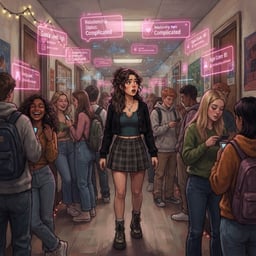
A woman puts on a set of cheap, trashy clothes she finds at a thrift store. The outfit refuses to come off and begins rewriting her from the outside in. Her body grows louder and more exaggerated, her speech coarsens, and her standards drop until she becomes the walking stereotype of a trashy, no-class slut.
Play as

A buttoned-up insurance adjuster with a tedious desk job and a quiet apartment, in town for her grandmother's estate sale. Sharp, guarded, and proud of her self-control — which is exactly what the outfit is undoing.
How it opens
The clearance bin is the kind of place things go to be forgotten — a tangle of stained Halloween costumes, single shoes, and one outfit folded neatly on top, like it wants to be found. Leopard-print top. Skirt short enough to be a rumor. Cheap, shiny, obviously trash. You'd never wear it, which is precisely why you pull it out, laughing at yourself a little, deciding it'll be a joke for the estate-sale wine night. The price tag is handwritten: $1.00. Under it, in older ink, someone has written NOT AGAIN.
In the fitting room mirror, the outfit looks absurd and — there's no better word for it — loud. It clings like it's glad. When you reach behind to unzip, the zipper isn't there. You turn the tag around. There's no tag anymore. There's no seam. The fabric has grown into your skin the way bark grows over wire, and when you press your fingers to your shoulder you feel the outfit press back.
Your reflection is still you, mostly. But the mirror lags half a second, and in that half-second, the woman in the glass pops a hip, winks, and mouths something at you. Your lips are still numb from where they said it. Outside the curtain, the store lights flicker, and somewhere near the register, Marv's voice says, flat and tired, like he's said it a hundred times: 'Ma'am. Please come out here slow. And whatever it told you in the mirror — don't agree to it.'
Setting
A run-down thrift store on the edge of a fading mill town, present day. In the clearance bin, a woman finds a garish outfit that should have been thrown away decades ago — and once it's on, it won't come off. Piece by piece, the outfit is rewriting her: body, voice, reputation, memories.
A branch can end when
- Dana is fully rewritten and becomes another smiling fixture of the town, like Ruthie
- Dana destroys or passes on the outfit, breaking the cycle at a cost
- Marv's shoebox leads Dana to a way out — or deeper in
More seeds like this